ЖLIBRE CODEX
LibraryAbout
ЖLIBRE CODEX

Read non-fiction classics for free.

Discover

Library

Learn

About

© 2026 LIBRE CODEX

The texts on this site are in the public domain.
Any editorial content (descriptions, annotations, reading paths) is licensed under CC BY-NC-ND 4.0.

ЖLIBRE CODEX
LibraryAbout
ЖLIBRE CODEX

Read non-fiction classics for free.

Discover

Library

Learn

About

© 2026 LIBRE CODEX

The texts on this site are in the public domain.
Any editorial content (descriptions, annotations, reading paths) is licensed under CC BY-NC-ND 4.0.

ЖLIBRE CODEX
LibraryAbout
Library / Aristotle
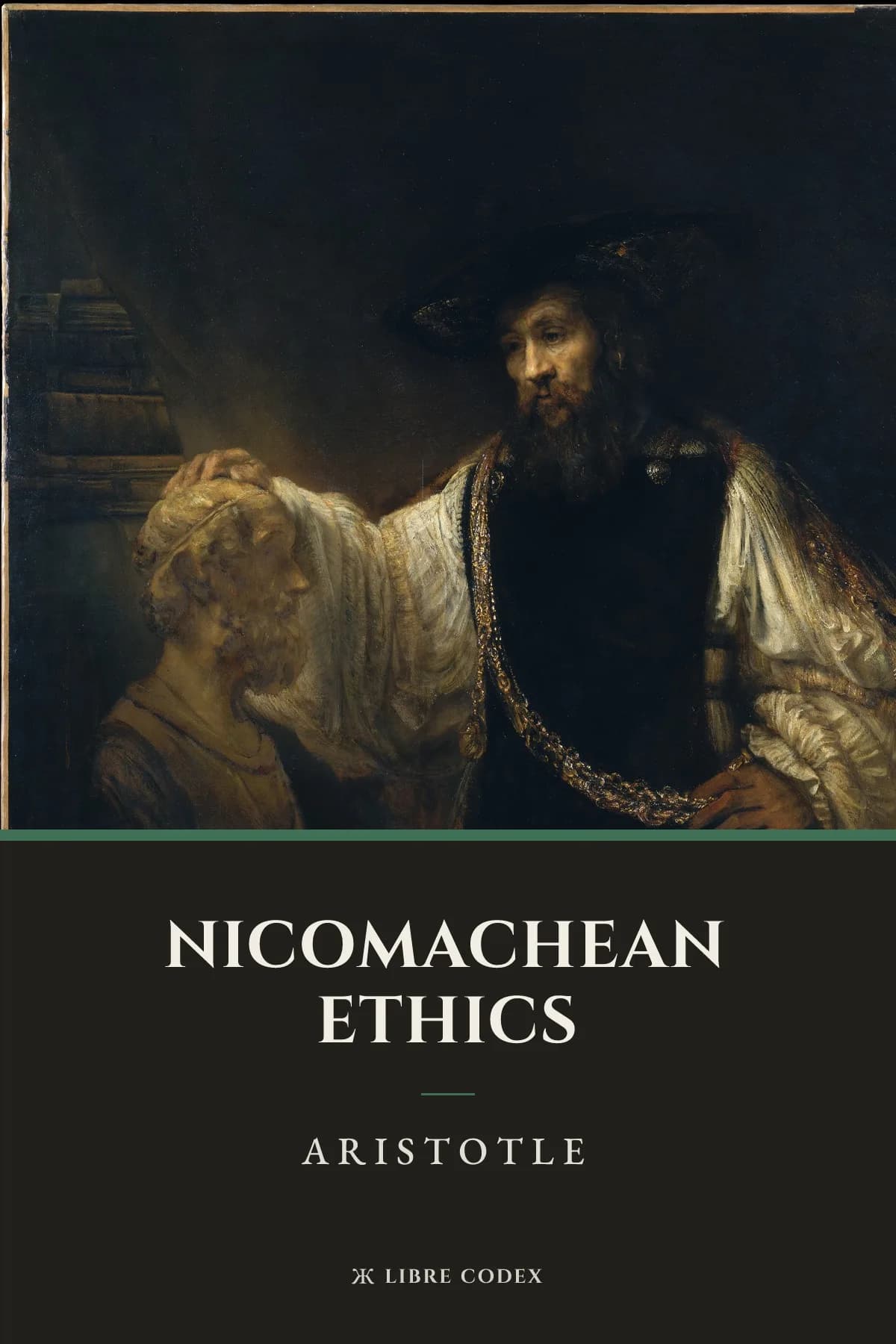
Cover of Nicomachean Ethics

Nicomachean Ethics

Aristotle · ancient · 89k words

The most important work of moral philosophy ever written — Aristotle’s lectures on how to live well. Its question is what the good life for a human being is, and its answer is eudaimonia, flourishing: the activity of the soul in accordance with virtue, over a complete life. Across ten books Aristotle works out what virtue is (a mean between extremes, formed by habit), examines courage, justice, and practical wisdom, devotes two books to friendship, and ends by crowning the contemplative life. Read section by section beside the Greek, on the Bekker grid scholars have cited for two centuries.

Start reading

Contents

Book I

  1. The good; the three lives14 min
  2. Happiness and the human function10 min
  3. Fortune, and the parts of the soul17 min

Book II

  1. Virtue comes about through habit11 min
  2. Virtue as a mean between extremes16 min

Book III

  1. The voluntary and the involuntary5 min
  2. Choice and deliberation9 min
  3. Wish, and responsibility for character9 min
  4. Courage9 min
  5. Temperance12 min

Book IV

  1. Liberality and its extremes9 min
  2. Magnificence and greatness of soul13 min
  3. Ambition, gentleness, good company18 min

Book V

  1. Justice, general and particular9 min
  2. Distributive and corrective justice14 min
  3. Natural justice and equity9 min
  4. Injustice to oneself13 min

Book VI

  1. The five intellectual virtues10 min
  2. Philosophic and practical wisdom9 min
  3. The uses of wisdom and prudence10 min

Book VII

  1. Continence and incontinence13 min
  2. Kinds of incontinence; brutishness17 min
  3. The nature of pleasure14 min

Book VIII

  1. Friendship and its three kinds13 min
  2. Equality, and friendship in the state14 min
  3. Friendship in family and community14 min

Book IX

  1. Conflicts between friends10 min
  2. Self-love and goodwill14 min
  3. Why the happy need friends14 min

Book X

  1. Pleasure reconsidered18 min
  2. Happiness and contemplation13 min
  3. Moral education; on to politics12 min

Text: H. Rackham translation, 1926 — public domain · source

Cover art: Rembrandt, Aristotle with a Bust of Homer (1653) — public domain

ЖLIBRE CODEX

Read non-fiction classics for free.

Discover

Library

Learn

About

© 2026 LIBRE CODEX

The texts on this site are in the public domain.
Any editorial content (descriptions, annotations, reading paths) is licensed under CC BY-NC-ND 4.0.